Thursday, 25 January 2018

BIRDWATCHING


This weekend is the Great British Garden Birdwatch https://www.rspb.org.uk/get-involved/activities/birdwatch/ 
so get counting.

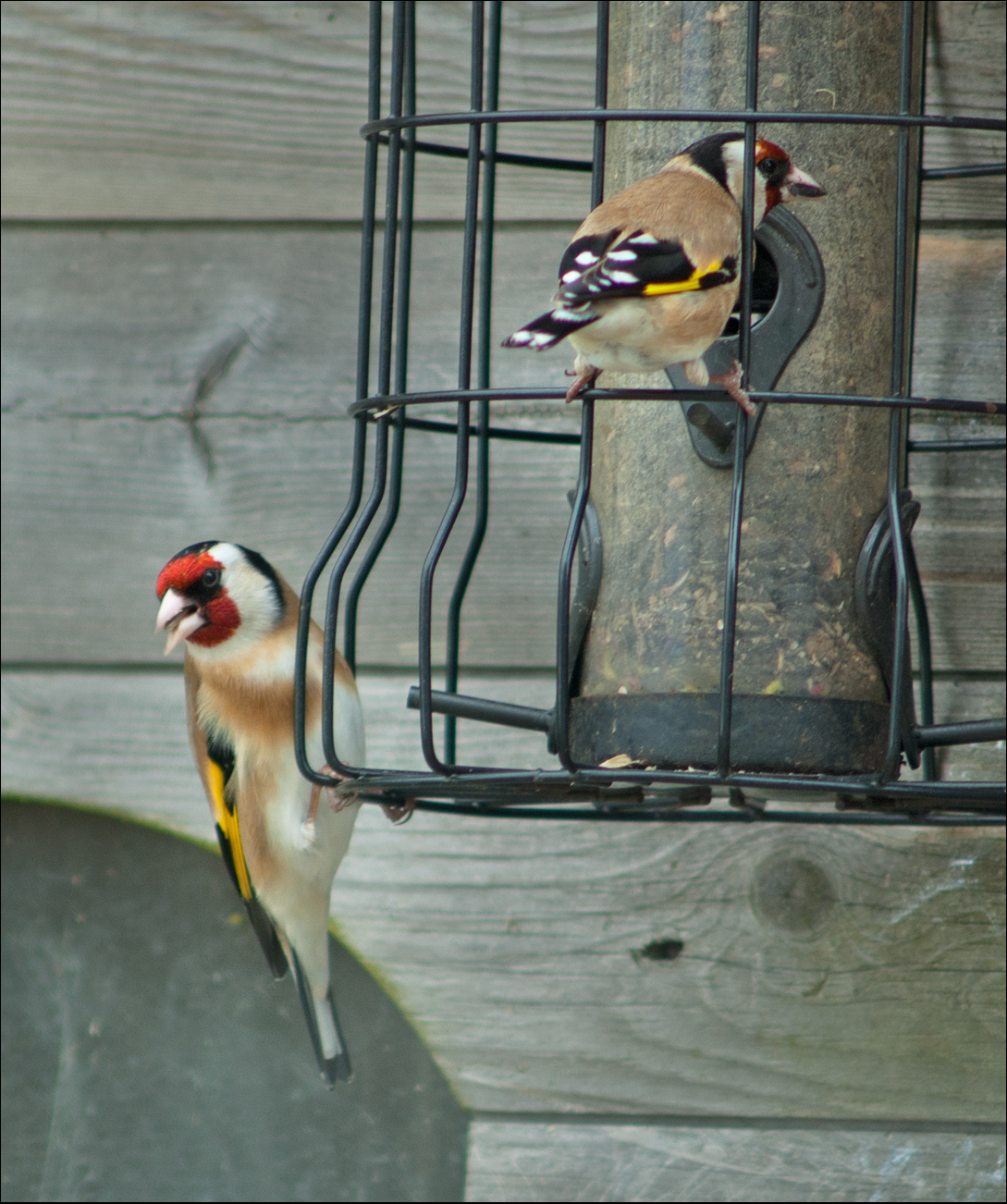
One of the arts of wildlife photography lies in good timing!


Whilst much pecking and feeding goes on above, blackbirds, chaffinches, bramblings
 and our resident mice scavenge on the ground.


Meanwhile above their heads we have a plethora (like that word) of visitors.
 
 Bullfinches and Greenfinches

 House Sparrows and Cock Chaffinches

Starlings and Goldfinches


 Woodpeckers and more Goldfinches


Hen Chaffinches and Siskins


Blue Tits and Great Tits


Tree Sparrows and Nuthatches

And then of course the dreaded Grey Squirrel, not to mention Pheasants and Moorhen and Jays and Magpies and so on.


So to other visitors at or near the feeders -

Wood Pigeons and Linnets


Robins and Rabbits


Pheasants of both gender 


Thrushes and Jays


Foxes and Rats


Even big toads.


So to the pond - no, enough! I hear. (And what about the videos of Badgers and Deer and so on.)

And the digging over and weeding and compost spreading goes on, when I can . . . 

Thursday, 18 January 2018

MARMALADE MADE

Before the sweet bit a little comment on the joys of the garden and otherwise - watching a flock of long tailed tits on the feeders, standing by the cutting bed admiring my work having weeded and prepared it - versus doing it. 

Marmalade made, 
 

rhubarb and ginger jam with the last of the frozen rhubarb done. 
As regards Sadie's recipe for marmalade here it is though I did give it a while back, enough when done to last a year -

9 Seville (bitter) oranges, one sweet one and a couple of lemons, squeeze out juice, put pips etc into muslin bag, put peel and pith through a mincer. Shove the lot into a big jam pan with bag of bits hanging in it. Leave 24 hours.
Bring to boil and simmer till ring soft - say a couple of hours.
Add 8 pounds sugar (I warm it in the bottom range oven first) and stir over low heat till all sugar dissolved, Boil hard for 10 minutes and begin testing by taking off heat and putting a small spoonful on plate chilled in fridge. Push with finger and when ripples - done. You may need to repeat this a few times if not yet ready, boiling for a minute or two and then testing again.
You may need to do it in 2 batches depending on pan size. 
Put into hot jars and seal, label and eat.
(Actually I left out the sweet orange this year as an experiment.)

Just been out cutting back the buddleia around the septic tank for something to do - too early really - should be left to end February or March. Snowdrops continue to come.


Then I cut away the Miscanthus, not the Stipa, and I know all this is early but I have to be ready for moving the rose bed and so on.

The photo below shows the bed between the two paths that will have to be cleared to give the builders access when they come - not yet done so still scruffy. The self sown alchemilla can go in the woodland edge or somewhere.

When we arrive at our back door - the one at the side of the house, not the front door which is at the back, we are now assailed by the perfume from the winter flowering sarcococcus.

And the dawn still reminds us that it is only January and winter has a distance to travel. You can just make out rooks flying behind the trees after being fed by the ladies with the horses in the paddock next door.


And so to the campaign to eradicate alien grey squirrels and preserve the reds. This involves trapping and killing the greys (who breed like rabbits?) It is all a bit tough on the greys who were brought to the country in the second half of the 1800s and then there is a part of me that finds it hard to kill. (Just as well as I used to be a doctor!) The greys are bigger, more aggressive and carry squirrel parapoxvirus virus which rarely kills a grey but to which the reds have little defence.
Well, I suppose men made the mess so . . . . 

Today I braved the bitter wind cutting in off the back field and put six new asparagus plants in the bed where old ones had gone.
Of course no shoots from them for a couple of years - but then!

Friday, 12 January 2018

OF APPLES AND THINGS

Peeling three Bramleys from the shed for a bit of stewed apple and cinnamon I was reminded of my father who would always regard an apple as a challenge - get the peel off in one go without breaking it. As far as eating eating (as opposed to baking) apples go I eat the lot, skin, core, pips (they have a slight almondy taste).
I am also looking at a large bowl of Seville oranges waiting to be turned into marmalade.
  To move on - we have had a gardener visit, after eleven years some help is at hand (perhaps reluctantly by me).
  We talked about replenishing the slate chipping paths and moving the rose bed with a view to the new upsizing and new siting area. Terms acceptable and he is the son of parents who were at school with me. (I hope that does not put him off?) So I have been weeding and clearing the rose bed until my fingers go dead. It is not the coldness but when they come round that is painful. Some of the roses are surprisingly feeble, perhaps underfed in too shallow soil, that will be remedied and we will see if we can revive them.
  First snowdrops in an egg cup in the kitchen, first blood blister of the year from my secateurs on my thumb. Bulbs coming through everywhere. Winter still with us but Spring is nudging the garden.
  Going out this morning (Sunday) and the farmer with his big tractor has snapped off the post with the electric gate button. I can tell it was he by the tyre tracks. Not a word of sorry, not a thing - just plain unneighbourly. I have cobbled some sort of support with a post and wire but will have to get it repaired. I have considered sending the bill to the farm but it would not do much good. Sigh!
  Just been out beginning to cut back the roses before transplanting later in the year - early spring best?

  There are certain objects that have moved around with us for some years - the rhubarb forcing pot, alas no lid, bought for a pound at an auction, a big lump of quartz carried down a mountain forty years ago, a sundial that belonged to R's grandmother and a small stone trough that belonged to my mother.

The trough has a small drainage hole in the base which is blocked and I will need to clear before planting up. I like the effect of the moss that has grown on it.
 
There are still some errant plants in the garden like this passion flower which continues to bud up, not die back and the primroses by the stream.


To change subject - some birds like robins are very territorial but recently I have noticed cock chaffinches at it too.

So tidying and a dry day leads to potash production - well, a bonfire. (Still smouldering a day and a half later.) The ash will go on the blackcurrants and such.

Having a one-armed wife (wrong arm)(broken wrist) leads to all sorts of surprises - cooking, ironing (the mystery of ironing a shirt), cleaning and putting in earrings. 

Currently making Cottage Pie (the one with beef not lamb (Shepherds' Pie)) for the freezer.

  And now it is time to cook the smoked haddock.

Thursday, 4 January 2018

A RESOLUTION AND A RANT


This is the view from home to the Nuclear Power Stations at Heysham over Morecambe Bay. I wonder what Wordsworth and Ruskin would say. 

New Year's Resolution - to try and make the garden more in harmony with nature without it becoming a chaotic jungle (though there is something in that idea)(will not be compatible with a control freak like me?).

I am reading John Lewis-Stempel's book, The Running Hare. The area where he lives in the Welsh Borders is very familiar as our daughter and her family live high on Orcop Hill. He bemoans the dreadful disaster that farming is inflicting on the natural world - I think too many people no longer living in harmony with their surroundings but exploiting it to its severe detriment.
Bird numbers in the rural environment have plummeted and the cities do not fare much better. Vast edgeless fields are empty of animal and insect life let along wild plants. 


So you say why a scruffy photo of a field with molehills? 
Well moles mean worms and worms mean a healthy pasture. This field is where a nearby farmer keeps sheep and cattle - so it is well fertilised - not only that he treats it with the muck-spreader once a year.

Pesticides and herbicides are lavished on crops - they are so safe that farmers who are spraying have to be in sealed tractor cabs!
And the chemicals enter the soil, wash off into the ditches, to the rivers and finally pollute the oceans.
We are gradually polluting and poisoning the world.

In the garden we encourage birds despite the predators - cats and grey squirrels etc - we have our pond, leave areas wild, make compost, have a lawn full of weeds like creeping buttercup. But we are a small, not quite two acre, patch in a world of factory farming.
I have a dream - I win the lottery and buy up farms, let some of the land go wild and then put in a farmer to cultivate in the old ways - that word harmony again.

And so to George Monbiot and his wilding - introducing lynx, beavers and wolves is irrelevant when what we need to do is live in harmony with the world about us. 
It is time for Chris Packham and the tribe to spend a series in the middle of a giant Norfolk wheat field and report almost nothing. (Apart from being sprayed with chemicals.)

Rant ended for now - a poem - or two -

THERE IS NO ROOM

There is no room for the wild,
we crowd it out.  The bees die -
no seed sets, no grain grows.
We wrap the world with our
insidious greed, plunder its riches.

We are too many.  Beyond our streets
the country is prey to geometric
habitation, block on block,
tar margined concrete plaque, 
reaching up as if to grasp the sky.

Is this now the time when politicians
should mention population,
realise a plague is here and we are it,
that in this war - election
and extinction versus common sense -

the winner will lose, we will all lose.
When fuel crops replace food, millions starve
but still drive their cars to supermarkets
for unhealthy goods they can’t afford to buy.
We were born with legs to walk

not to press accelerators, brakes -
with mouths to talk, to shout.
And if we do nothing - we will be gone,
for the balance will be restored.

With or without us Earth will turn.


DISEASE

It has rained, roofs are moonlight.
Geese wedge west, tug at the heart.
At the back of a blackthorn hedge
badgers half bark, half cough. Owls trade claims.

Rubbish is stacked by the gate, waits for the six a.m. wagon.
The world should be at ease but the drone of the traffic
drowns the peace, street lights, reflected from scattered clouds,
snuff stars, cast amber shadows on the tar.  

A farm dog on a night out rips black plastic, spreads waste.
It has rained, drains are blocked, chemicals flood 
from stinking fields, geese choke, owls are silent,
there is no lichen on the blackthorn bark,

It took ten thousand years and an Ice Age.
Man is gone. Now there are only scars and archaeology.
Blackthorn are heavy with sloes, owls hunt the scrub,
there are badgers in the woods.

From the mound of fresh earth at a sett’s mouth
a shred of black protrudes - the remnant of a bin bag.
To the west geese skein in to tide-washed turf,
apes forage in the rushes.

Friday, 29 December 2017

2017 A YEAR BETWEEN WINTERS


Before I summarise the last year here is today in all its slushy, cold glory. We are on the snow line and in the top left hand corner is the new feeder S and K gave us for Christmas.


And a happy New Year.

Back to the blog - 
Where does it all come from? Looking back through the year at woodland brimming with vegetation, roses heavy with flowers and so on - where does it all go?


In the early spring the days lengthen and the first leaves come with rhubarb bursting from their crowns.


Then the cherry blossom erupts


to be followed by leaves.


The borders are full of forgetmenots and tulips,


then hesperus and alliums.


The way to the wood past the oriental poppy bed 


leads to a wild display of campion and pignut.


Aquilegia, self sown, flowers wherever it likes


and the roses and crambe bring drama to the garden.


The garden is haven for birds like the nesting pheasants


and there are mallard on the pond.


 The year moves on through waterfalls of Rose Rambling Rector.


Gradually later plants emerge - the Japanese Anemones complementing the resurgence of flowers on the roses.


And then the shadows lengthen as September comes with dew and a different light.


Harvests are taken,


the leaves turn and fall -


Where does it all come from - where does it all go?